


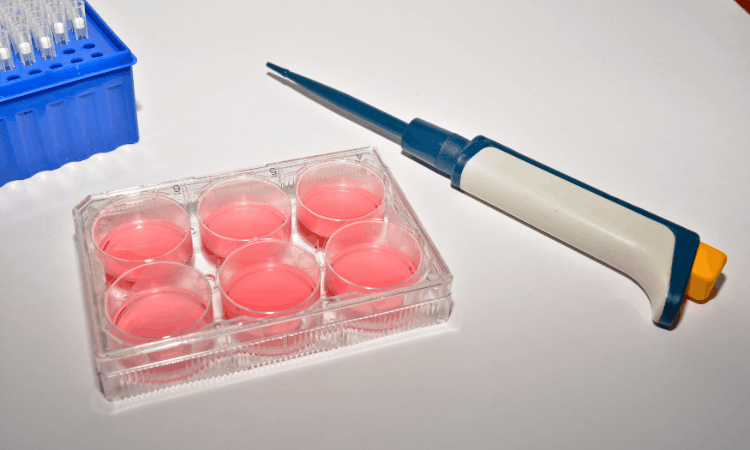
Тестирование на цитотоксичность: межсекторальный научный подход от фармацевтики до косметики, медицинских устройств и продуктов питания
Цитотоксичность относится к совокупности токсических эффектов, которые вещество или материал оказывают на клетки. Эти эффекты могут проявляться как гибель клеток (некроз или апоптоз), повреждение клеточной мембраны, снижение метаболической активности, остановка пролиферации клеток и морфологические изменения. Тестирование на цитотоксичность позволяет количественное или качественное измерение этих эффектов при in vitro Это первый и самый важный шаг в оценке биосовместимости. Наша лаборатория проводит тесты на цитотоксичность в соответствии с нормативными требованиями различных секторов в соответствии с принципами GLP и GMP.
Распределение исследований цитотоксичности, которые мы проводили в нашей лаборатории за последние три года, четко подчеркивает различия между секторами: на запросы производителей медицинских устройств приходится примерно половина всех исследований, в то время как косметика и средства личной гигиены занимают второе место, а фармацевтические препараты и биологические продукты занимают третье место. Уникальная нормативная база каждого сектора напрямую влияет на критерии проектирования и интерпретации тестов. В этой статье мы поделимся научными основами тестирования цитотоксичности, отраслевыми различиями и опытом нашей лаборатории.
Научная основа и значение тестирования на цитотоксичность
Цитотоксичность считается первым шагом в оценке биосовместимости. Если вещество или материал является цитотоксическим, то, как правило, нет необходимости проводить дальнейшие тесты (сенсибилизация, раздражение, имплантация), так как цитотоксичность свидетельствует о серьезной несовместимости на клеточном уровне. Таким образом, тест является критически важным инструментом скрининга как для безопасности пациента / пользователя, так и для эффективного использования ресурсов производителя.
Наиболее значительным преимуществом теста является то, что он не требует использования животных и обеспечивает быстрые, экономически эффективные и воспроизводимые результаты. Эти методы, основанные на клеточной культуре, полностью соответствуют принципу «замены» 3R. Однако наш опыт показывает, что тест на цитотоксичность не должен рассматриваться как простое средство скрининга. Особенно в сложных составах и биологических продуктах, разработка тестов и интерпретация результатов требуют значительных знаний.
Результаты испытаний на цитотоксичность непосредственно используются в маркировке продукции, подготовке паспортов безопасности (SDS), нормативных представлениях и проверке качества продукции. Кроме того, оценка цитотоксического потенциала сырья, добавок, агентов высвобождения плесени и остатков стерилизации считается показателем надежности производственного процесса.
Методы тестирования цитотоксичности в промышленности
Тестирование цитотоксичности для медицинских устройств проводится в соответствии с ISO 10993-5:2009 стандарт. Настоящий стандарт определяет оценку цитотоксических эффектов путем применения экстрактов, полученных из устройства или самого материала устройства, непосредственно к клеточным культурам. Для метода экстракции были определены три основных подхода: прямой контакт и наложение агара. Наиболее распространенной проблемой, с которой мы сталкиваемся в нашей лаборатории при работе с медицинскими устройствами, является выбор метода тестирования, подходящего для физической формы устройства. Например, метод прямого контакта может давать вводящие в заблуждение результаты для устройств с нерегулярными поверхностями или содержащими частицы; в таких случаях предпочтительны наложение агара или модифицированные протоколы экстракции.
Тестирование на цитотоксичность косметических и средств личной гигиены Необходимо проводить с использованием in vitro methods, as animal testing is prohibited under the EU Cosmetics Regulation (EC 1223/2009). In this sector, the 3T3 NRU phototoxicity test (OECD TG 432) and RhE models are the most commonly used. In our field experience, we have observed that cytotoxicity results in cosmetic products are extremely sensitive to the product’s concentration and exposure time. The same raw material can exhibit different cytotoxic profiles at different concentrations; therefore, the product’s actual concentration of use must be taken into account in test design.
For pharmaceuticals and biological products, cytotoxicity testing is conducted in accordance with ICH guidelines and pharmacopeia monographs. In this sector, the test typically appears not so much as a cytotoxicity screening but rather as part of the safety evaluation of cell-based therapeutics (CAR-T, stem cells). For biological products, cytotoxicity testing is used to assess the toxicity of excipients used in the manufacturing process (e.g., culture medium components, transfection agents) rather than the product itself. Case study: In a cell therapy product, we identified that a polymer residue used in the manufacturing process was cytotoxic and helped the manufacturer optimize its purification steps.
Cytotoxicity testing for food and food-contact materials is used in the safety assessment of food additives and packaging materials. In this sector, testing is typically conducted in accordance with EFSA and FDA guidelines. Based on our field experience, we have observed that the cytotoxicity assessment of migration products from food packaging materials is particularly challenging, as the amount and duration of migration vary significantly depending on the type of food and storage conditions.
The table below summarizes cytotoxicity testing approaches and regulatory references by industry.
| Sector | Primary Standard | Common Test Methods | Key Challenge |
|---|---|---|---|
| Медицинские приборы | ISO 10993-5:2009 | Extraction, direct contact, agar overlay; MTT/NRU/XTT | Selection of a method appropriate for the device’s physical form |
| косметика | EU Cosmetics Regulation (EC 1223/2009) | 3T3 NRU phototoxicity (TG 432), RhE models; MTT | Modeling of actual use concentrations |
| Drugs/Biological Products | ICH guidelines, Pharmacopoeia | Cell-based assays; MTT, XTT, lactate dehydrogenase (LDH) | Evaluation of manufacturing process residues |
| Food/Food Contact Materials | EFSA, FDA guidelines | Migration extracts; MTT, NRU | Standardization of migration amount and duration |
Cell Viability Measurement Methods: A Comparative Evaluation of MTT, NRU, and XTT
Различные колориметрические методы используются для измерения жизнеспособности клеток в анализах цитотоксичности. Эти методы косвенно определяют количество живых клеток путем измерения клеточной метаболической активности или целостности мембраны. Три наиболее часто используемых метода - MTT, NRU и XTT.
Анализ MTT is based on the principle that MTT tetrazolium salt is reduced by mitochondrial dehydrogenase enzymes in cells, converting it into purple-colored formazan crystals. The formazan crystals produced in live cells are dissolved in a suitable solvent and measured spectrophotometrically. The MTT assay is a fast, economical, and widely used method. However, in our field experience, we have observed that the MTT assay can be subject to interference from certain substances. For example, substances with strong reducing properties (ascorbic acid, certain polyphenols) can directly reduce MTT, leading to false-positive results. In such cases, we recommend verification using alternative methods such as the NRU or XTT assays.
NRU (нейтральное красное поглощение) is based on the ability of live cells to accumulate neutral red dye in their lysosomes. Live cells actively take up neutral red and store it in lysosomes; dead cells, however, cannot take up this dye. The dye is extracted using an acidic alcohol solution and measured spectrophotometrically. The NRU assay is used specifically to evaluate membrane integrity and lysosomal function; it may provide more stable results compared to the MTT assay. In our laboratory, we use the NRU assay as the primary validation method for substances suspected of causing MTT interference.
Анализ XTT is based on the principle of the reduction of XTT—a tetrazolium salt similar to that used in the MTT assay—by cells. The most significant advantage of XTT is that it forms a water-soluble formazan product; therefore, the dissolution step required in the MTT assay is not necessary. The XTT assay is faster and requires fewer procedural steps. However, there are situations where XTT exhibits lower sensitivity compared to MTT; this difference becomes particularly noticeable at low cell densities and in slowly proliferating cell lines.
The table below provides a comparative summary of the key characteristics of the MTT, NRU, and XTT methods.
| Возможность | МТТ | НРУ | XTT |
|---|---|---|---|
| Принцип измерения | Mitochondrial dehydrogenase activity | Neutral red uptake by lysosomes | Уменьшение тетразолия (водорастворимый формазан) |
| Formazan Solubility | Insoluble (requires a solubilization step) | Dye extraction required | Water-soluble (no solubilization step required) |
| Risk of Interference | High (with reducing agents) | Low | Умеренный |
| Incubation Time | 2–4 hours | 2–4 hours | 1–2 hours |
| Use in Our Laboratory | Primary screening test (all sectors) | Confirmation in cases of suspected MTT interference | Rapid screening and high-throughput studies |
Implementation of Cytotoxicity Tests and Field Observations in Our Laboratory
In our GLP- and GMP-certified laboratory, we conduct cytotoxicity tests in accordance with industry-specific regulatory requirements. Our testing process begins with a comprehensive preliminary evaluation: the test substance’s physicochemical properties, solubility, pH value, chemical structure, and potential interferences are examined. Based on this information, the most appropriate test method (extraction, direct contact, or agar overlay) and cell viability measurement technique (MTT, NRU, or XTT) are determined.
One of the most common challenges we encounter in our fieldwork is the solubility of the test substance. For substances that are insoluble in water, extraction efficiency may decrease, leading to false-negative results. In such cases, we perform extraction using non-polar solvents (vegetable oil, DMSO) and evaluate the results in conjunction with those from polar extracts. Another issue is interference in spectrophotometric measurements caused by colored or opaque substances. In such cases, we prepare appropriate blank samples or switch to alternative measurement methods (e.g., fluorescence-based tests).
One of our laboratory’s key advantages is its ability to offer customized testing strategies for different device and product types. For liquid products, direct application is used; for solid devices, direct contact or extraction; for materials containing particles, agar overlay; and for devices with irregular surfaces, modified extraction protocols are employed. This flexibility ensures that the unique characteristics of each product are accurately evaluated.
Test results are presented in a comprehensive test report format compliant with ISO 10993-5:2009 (medical devices) or the relevant industry standard. The report includes sections on the test method, cell line, extraction conditions, cell viability data, morphological observations, statistical analyses, and interpretation. Our reports comply with the requirements of the EU MDR (2017/745), FDA 510(k), the EU Cosmetics Regulation, ICH, and EFSA.
Часто Задаваемые Вопросы
One of the most common questions we receive about cytotoxicity testing is which test method is appropriate for which product. The selection depends on the product’s physical form, industry sector, and regulatory requirements. For medical devices, extraction, direct contact, or agar overlay methods are used under ISO 10993-5; for cosmetics, RhE models and 3T3 NRU; for pharmaceuticals, cell-based tests in accordance with ICH guidelines; and for food contact materials, migration extracts are used. Our laboratory evaluates your product’s characteristics and recommends the most appropriate method.
The difference between MTT, NRU, and XTT tests is also frequently asked. MTT measures mitochondrial activity and requires the dissolution of formazan crystals; it may be subject to interference from reducing agents. The NRU assay evaluates lysosomal function and provides information on membrane integrity; the risk of interference is low. The XTT assay, on the other hand, is faster and requires fewer steps because it produces a water-soluble formazan product. The choice of method depends on the product’s characteristics and the laboratory’s preference; however, all methods are validated and internationally recognized.
Regarding the test duration, the total time—including cell culture preparation, extraction, incubation, and measurement steps—is generally 2–4 weeks. Including reporting and quality assurance reviews, this period may extend to 4–6 weeks. As for which products are subject to cytotoxicity testing, the answer is that a cytotoxicity assessment is required for all products that come into contact with cells or tissues. This is the first and most fundamental step in biocompatibility assessment.
Finally, there is often curiosity about what should be done if a product is found to be “cytotoxic” as a result of the cytotoxicity test. In this case, the manufacturer must review the material composition, the production process (mold release agents, solvents, additives), and the sterilization method. Our laboratory offers advanced analytical methods—such as extraction fractionation, chemical analysis, and alternative material testing—to identify the source of the problem. The goal is to ensure the product’s safety and compliance with regulatory requirements.
A cytotoxicity test provides scientific evidence of your product’s safety at the cellular level. Whether it is a medical device, cosmetic, pharmaceutical product, or food-contact material, a properly designed cytotoxicity study forms the foundation of the biocompatibility profile and represents the first critical step in the regulatory approval process. Our laboratory evaluates your product’s cellular compatibility to the highest scientific standards using MTT, NRU, and XTT methods, along with extraction, direct contact, and agar overlay techniques. To be your trusted partner on your product’s biocompatibility journey, contact us.


