

OECD TG 439 and ISO 10993-23: The Rise of In Vitro Methods for Skin Irritation
Assessing the potential for skin irritation resulting from contact with chemicals and medical devices is an indispensable requirement for both user safety and regulatory compliance. While in the past this assessment was conducted exclusively through animal testing, scientific and ethical advancements have led to in vitro methods becoming the preferred approach. Two key milestones in this transition are the OECD TG 439 and ISO 10993-23 standards. Our laboratory implements both standards in accordance with GLP and GMP principles, using validated reconstituted human epidermis (RhE) models.
The Scientific Basis of In Vitro Skin Irritation Tests
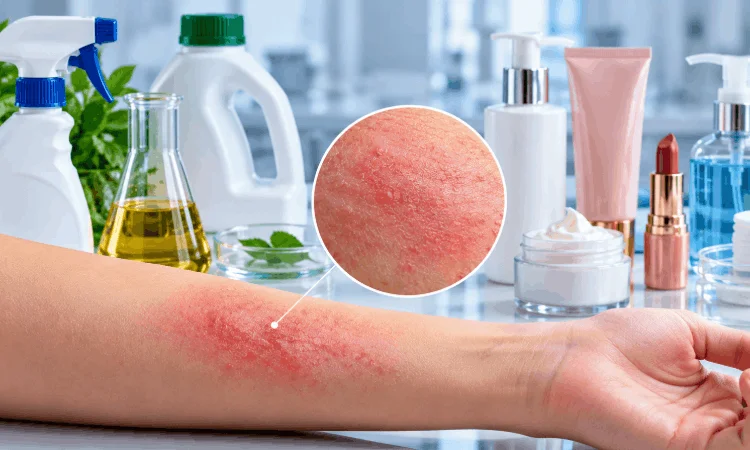
Skin irritation is a local, typically reversible inflammatory response resulting from a substance’s contact with the skin. Clinically, it manifests as erythema (redness), edema (swelling), dryness, peeling, and itching. In traditional in vivo tests, this response is evaluated through visual scoring in a rabbit model; in vitro methods, on the other hand, use three-dimensional tissue models that mimic the structural and functional characteristics of human skin. These models are reconstituted human epidermis (RhE) tissues derived from human keratinocytes that preserve the multilayered structure of the epidermal layer, the lipid barrier, and metabolic activity.
The basic principle of the in vitro skin irritation test is to apply the test substance to the RhE tissue for a specific period of time and then measure cell viability. Cell viability is determined using the MTT assay; this test is based on the principle that MTT tetrazolium salt is reduced by mitochondrial dehydrogenase enzymes in living cells, converting it into purple-colored formazan crystals. The formazan crystals are dissolved in a suitable solvent and measured spectrophotometrically. The percentage of cell viability is calculated by comparison with a negative control. If cell viability falls below a certain threshold value (typically 50 percent), the substance is classified as “irritating.”
The most significant advantage of this approach is that it allows for direct extrapolation to human skin. Structural and physiological differences between animal and human skin can limit the predictive power of in vivo tests. Since RhE models directly reflect human biology, the results are more consistent with clinical reality. Furthermore, by completely eliminating the use of animals, these methods fully comply with the “Replacement” principle of the 3Rs.
OECD TG 439: In Vitro Skin Irritation Test for Chemicals
OECD TG 439 is an internationally recognized in vitro test guideline developed to assess the skin irritation potential of chemical substances and mixtures. This guideline was adopted in 2015 and updated in 2021. Under TG 439, the skin irritation potential of the test substance is evaluated using validated RhE models (EpiSkin™, EpiDerm™, SkinEthic™ RHE, LabCyte EPI-MODEL24, etc.). The test involves a single application period (typically 15 minutes or 4 hours) followed by a 42-hour incubation period. Cell viability is measured using the MTT assay, and the results are interpreted by comparing them to negative and positive controls.
The most important feature of TG 439 is that it provides sufficient data for GHS (Globally Harmonized System) classification. Test results can be used to classify a substance as “Skin Irritant” (Category 2) or “Not Irritating.” However, TG 439 evaluates only irritation potential; separate tests (OECD TG 430, 431, or 435) are required to assess corrosion potential. TG 439 is widely used, particularly for cosmetic products, personal care products, cleaning agents, and industrial chemicals.
Under the EU Cosmetics Regulation (EC 1223/2009), animal testing for cosmetic products and their ingredients is completely prohibited. Therefore, TG 439 has become a mandatory test for the cosmetics industry. Furthermore, under the EU REACH Regulation , the use of methods is encouraged, and animal testing is prohibited where validated alternatives are available. TG 439 plays a central role within this regulatory framework.
ISO 10993-23: Skin Irritation Test for Medical Devices
ISO 10993-23 is the international standard defining skin irritation tests as part of the biocompatibility assessment of medical devices. This standard is an updated version of the irritation tests originally included in ISO 10993-10, now established as a separate standard. ISO 10993-23 evaluates the effects of extracts obtained from the device or the device material itself on the skin in a manner that best reflects the medical device’s clinical usage scenario.
The most significant innovation of ISO 10993-23 is its prioritization of in vitro methods.
The standard recommends the use of validated RhE models as the first choice for skin irritation assessment. These models operate on the same principle as OECD TG 439; however, ISO 10993-23 defines extraction conditions and sample preparation protocols specific to medical devices. For example, extracts are prepared from the device using polar (serum-containing medium) and non-polar (vegetable oil) solvents in accordance with ISO 10993-12; extraction temperatures and durations are determined to reflect the device’s clinical use.
The most significant difference between ISO 10993-23:2021 and previous versions is its adoption of a risk-based approach to test method selection and its stronger emphasis on the use of in vitro methods. The standard states that, based on chemical characterization data and available literature, an irritation assessment can be completed without animal testing in certain cases. Furthermore, it acknowledges that when the in vitro method is not appropriate or the results are inconclusive, the in vivo skin irritation test (patch test on rabbits or human volunteers) may be used as an alternative.
The table below provides a comparative summary of the key features of the OECD TG 439 and ISO 10993-23 standards.
| Feature | OECD TG 439 | ISO 10993-23 |
|---|---|---|
| Scope | Chemical substances, mixtures, cosmetics, cleaning products | Medical devices and biomaterials |
| Primary Method | In vitro RhE model (primary and sole method) | In vitro RhE model (primary); in vivo alternative when necessary |
| Test System | EpiSkin™, EpiDerm™, SkinEthic™ RHE, LabCyte EPI-MODEL24 | Same RhE models; device extract or direct material application |
| Sample Preparation | Test substance applied directly (liquid, solid, paste) | Extraction in accordance with ISO 10993-12 (polar and non-polar solvents) |
| Evaluation | Cell viability (MTT assay, % viability threshold) | Cell viability (MTT assay) + morphological changes |
| Regulatory References | EU REACH, CLP, EU Cosmetics Regulation, GHS | EU MDR (2017/745), ISO 10993-1, FDA 510(k) |
| 3R Compliance | Full (no animal use) | High (in vitro priority; in vivo only as a last resort) |
Advantages and Limitations of RhE Models
Reconstituted human epidermis (RhE) models form the core of in vitro skin irritation testing. The most significant advantage of these models is that they preserve the multilayered structure, lipid barrier, and metabolic activity of human skin, thereby providing a realistic response to test substances. RhE tissues contain differentiated cell layers ranging from the basal layer to corneocytes; this allows for accurate modeling of chemical penetration through the skin and the epidermal response. Furthermore, since these models are commercially available, standardized, and validated, the results demonstrate high reproducibility across laboratories.
Another advantage of RhE models is their ethical and economic benefits. By completely eliminating the use of animals, they fully comply with the 3R principles; they shorten testing time (hours instead of days); they reduce costs; and they simplify ethical committee approval processes. Particularly in the cosmetics industry, RhE models are the only mandatory option due to the ban on animal testing in the EU.
However, RhE models also have certain limitations. These models consist solely of the epidermal layer; they do not include other components of the skin, such as the dermis, blood vessels, immune cells, and nerve endings. Therefore, processes such as dermal-epidermal interactions, vascular responses, and neurogenic inflammation cannot be fully modeled. Additionally, certain test substances (e.g., water-insoluble solids, strong acids/bases) may yield inaccurate results in RhE models; in such cases, additional evaluation or in vivo validation may be required. Aware of these limitations, our laboratory tailors the testing strategy for each product and provides complementary analyses when necessary.
Implementation of OECD TG 439 and ISO 10993-23 Tests in Our Laboratory
In our GLP- and GMP-certified laboratory, we conduct skin irritation tests under both OECD TG 439 and ISO 10993-23 in full compliance with international standards. For in vitro tests, we use validated RhE models (EpiSkin™, EpiDerm™, SkinEthic™); in cases where in vivo testing is unavoidable, we operate in full compliance with the 3R principles under the supervision of experienced veterinarians and toxicologists.
Our testing process begins with a comprehensive preliminary evaluation. The test substance’s physicochemical properties, solubility, pH value, and chemical structure are examined. For medical devices, the device’s material composition, manufacturing process, sterilization method, and clinical usage scenario are evaluated in detail. Based on this information, the most appropriate extraction protocol and test method are determined.
In the RhE test, the test substance or extract is applied to a tissue model, and after a specified incubation period, cell viability is measured using the MTT assay. The results are interpreted by comparing them with negative and positive controls. Substances with cell viability below 50 percent are classified as “irritants.” Morphological evaluation serves as an important complement to the numerical data; tissue integrity, cell shape, and layer structure are examined under a microscope.
One of our laboratory’s key advantages is that test results can be directly integrated into your regulatory submissions. Reports compliant with OECD TG 439 are valid for EU REACH, CLP, and cosmetic regulations. Reports compliant with ISO 10993-23 are accepted for the EU MDR (2017/745), FDA 510(k), and other medical device regulations. Additionally, for both standards, we provide comprehensive reports that include chemical characterization data, extraction details, cell viability results, and morphological observations.
Frequently Asked Questions
One of the most common questions we receive regarding OECD TG 439 and ISO 10993-23 is which standard is appropriate for which product. OECD TG 439 applies to chemical substances, mixtures, cosmetics, and cleaning products. ISO 10993-23, on the other hand, was specifically developed for medical devices and biomaterials. The choice depends on your product’s regulatory category; our laboratory will evaluate your product’s characteristics and recommend the most appropriate standard.
In vitro test results are often asked whether they can replace in vivo tests. Yes, in many cases they can. OECD TG 439 and ISO 10993-23 allow for classification without the need for in vivo testing, provided that validated RhE models are used. However, if test results are inconclusive, the substance is insoluble in water, or the regulatory authority specifically requests it, in vivo validation may be required.
There is also interest in which commercial brands of RhE models are available and which one should be preferred. EpiSkin™, EpiDerm™, SkinEthic™ RHE, and LabCyte EPI-MODEL24 are OECD-validated and internationally recognized RhE models. The choice of model depends on the characteristics of the test substance and the laboratory’s validation status; all models operate on a similar principle and provide comparable results.
Regarding the test duration, the RhE test typically yields results within 1–2 weeks; the total duration, including reporting and quality assurance review, is 3–4 weeks. If in vivo validation is required, this period may extend to 4–6 weeks. Finally, the question arises as to which regulatory submissions these tests can be used for. OECD TG 439 reports are valid for EU REACH, CLP, cosmetic regulations, and GHS classification; ISO 10993-23 reports are valid for the EU MDR, FDA 510(k), and other medical device regulations.
In vitro methods for skin irritation assessment form the foundation of a modern approach that combines scientific accuracy with ethical responsibility. With our tests, which are fully compliant with OECD TG 439 and ISO 10993-23 standards, we evaluate the skin safety of your products according to the highest scientific standards—without the need for animal testing. Our GLP- and GMP-certified laboratory, equipped with validated RhE models and an experienced team, is your reliable partner for skin irritation testing needs. To demonstrate your product’s skin safety, contact us.


