


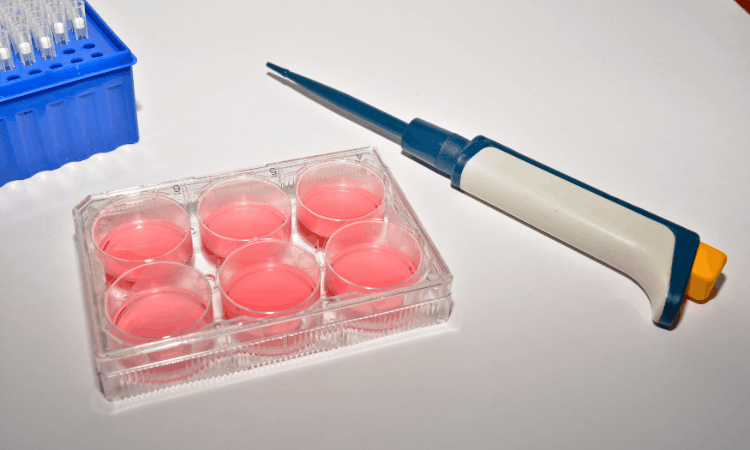
Cytotoxicity Testing: A Cross-Sectoral Scientific Approach from Pharmaceuticals to Cosmetics, Medical Devices to Food
Cytotoxicity refers to the totality of toxic effects that a substance or material exerts on cells. These effects may manifest as cell death (necrosis or apoptosis), cell membrane damage, decreased metabolic activity, arrest of cell proliferation, and morphological changes. Cytotoxicity testing enables the quantitative or qualitative measurement of these effects under in vitro conditions and constitutes the first and most critical step in biocompatibility assessment. Our laboratory conducts cytotoxicity tests in accordance with the regulatory requirements of various sectors, under GLP and GMP principles.
The distribution of cytotoxicity studies we have conducted in our laboratory over the past three years clearly highlights the differences across sectors: Requests from medical device manufacturers account for approximately half of all studies, while cosmetics and personal care products rank second, and pharmaceuticals and biological products rank third. Each sector’s unique regulatory framework directly influences test design and interpretation criteria. In this article, we will share the scientific basis of cytotoxicity testing, sector-specific differences, and our laboratory’s field experience.
The Scientific Basis and Importance of Cytotoxicity Testing
Cytotoxicity testing is considered the first step in biocompatibility assessment. If a substance or material is cytotoxic, there is generally no need to conduct further tests (sensitization, irritation, implantation), as cytotoxicity indicates a serious incompatibility at the cellular level. Therefore, the test is a critical screening tool both for patient/user safety and for the efficient use of the manufacturer’s resources.
The test’s most significant advantage is that it does not require the use of animals and provides rapid, cost-effective, and reproducible results. These cell culture-based methods fully comply with the “Replacement” pillar of the 3R principles. However, our field experience shows that the cytotoxicity test should not be viewed as merely a “simple screening” tool. Especially in complex formulations and biological products, test design and result interpretation require significant expertise.
Cytotoxicity test results are directly used in product labeling, the preparation of safety data sheets (SDS), regulatory submissions, and the validation of production quality. Furthermore, the evaluation of the cytotoxic potential of raw materials, additives, mold release agents, and sterilization residues is considered an indicator of the reliability of the production process.
Cytotoxicity Testing Approaches by Industry
Cytotoxicity testing for medical devices is conducted in accordance with the ISO 10993-5:2009 standard. This standard specifies the evaluation of cytotoxic effects by applying extracts obtained from the device or the device material itself directly to cell cultures. Three basic approaches have been defined for the extraction method: direct contact and agar overlay. The most common challenge we face in our laboratory when working with medical devices is selecting a test method appropriate for the device’s physical form. For example, the direct contact method may yield misleading results for devices with irregular surfaces or containing particles; in such cases, agar overlay or modified extraction protocols are preferred.
Cytotoxicity testing for cosmetic and personal care products is required to be conducted using in vitro methods, as animal testing is prohibited under the EU Cosmetics Regulation (EC 1223/2009). In this sector, the 3T3 NRU phototoxicity test (OECD TG 432) and RhE models are the most commonly used. In our field experience, we have observed that cytotoxicity results in cosmetic products are extremely sensitive to the product’s concentration and exposure time. The same raw material can exhibit different cytotoxic profiles at different concentrations; therefore, the product’s actual concentration of use must be taken into account in test design.
For pharmaceuticals and biological products, cytotoxicity testing is conducted in accordance with ICH guidelines and pharmacopeia monographs. In this sector, the test typically appears not so much as a cytotoxicity screening but rather as part of the safety evaluation of cell-based therapeutics (CAR-T, stem cells). For biological products, cytotoxicity testing is used to assess the toxicity of excipients used in the manufacturing process (e.g., culture medium components, transfection agents) rather than the product itself. Case study: In a cell therapy product, we identified that a polymer residue used in the manufacturing process was cytotoxic and helped the manufacturer optimize its purification steps.
Cytotoxicity testing for food and food-contact materials is used in the safety assessment of food additives and packaging materials. In this sector, testing is typically conducted in accordance with EFSA and FDA guidelines. Based on our field experience, we have observed that the cytotoxicity assessment of migration products from food packaging materials is particularly challenging, as the amount and duration of migration vary significantly depending on the type of food and storage conditions.
The table below summarizes cytotoxicity testing approaches and regulatory references by industry.
| Sector | Primary Standard | Common Test Methods | Key Challenge |
|---|---|---|---|
| Medical Devices | ISO 10993-5:2009 | Extraction, direct contact, agar overlay; MTT/NRU/XTT | Selection of a method appropriate for the device’s physical form |
| Cosmetics | EU Cosmetics Regulation (EC 1223/2009) | 3T3 NRU phototoxicity (TG 432), RhE models; MTT | Modeling of actual use concentrations |
| Drugs/Biological Products | ICH guidelines, Pharmacopoeia | Cell-based assays; MTT, XTT, lactate dehydrogenase (LDH) | Evaluation of manufacturing process residues |
| Food/Food Contact Materials | EFSA, FDA guidelines | Migration extracts; MTT, NRU | Standardization of migration amount and duration |
Cell Viability Measurement Methods: A Comparative Evaluation of MTT, NRU, and XTT
Various colorimetric methods are used to measure cell viability in cytotoxicity assays. These methods indirectly determine the number of live cells by measuring cellular metabolic activity or membrane integrity. The three most commonly used methods are MTT, NRU, and XTT.
The MTT assay is based on the principle that MTT tetrazolium salt is reduced by mitochondrial dehydrogenase enzymes in cells, converting it into purple-colored formazan crystals. The formazan crystals produced in live cells are dissolved in a suitable solvent and measured spectrophotometrically. The MTT assay is a fast, economical, and widely used method. However, in our field experience, we have observed that the MTT assay can be subject to interference from certain substances. For example, substances with strong reducing properties (ascorbic acid, certain polyphenols) can directly reduce MTT, leading to false-positive results. In such cases, we recommend verification using alternative methods such as the NRU or XTT assays.
The NRU (Neutral Red Uptake) assay is based on the ability of live cells to accumulate neutral red dye in their lysosomes. Live cells actively take up neutral red and store it in lysosomes; dead cells, however, cannot take up this dye. The dye is extracted using an acidic alcohol solution and measured spectrophotometrically. The NRU assay is used specifically to evaluate membrane integrity and lysosomal function; it may provide more stable results compared to the MTT assay. In our laboratory, we use the NRU assay as the primary validation method for substances suspected of causing MTT interference.
The XTT assay is based on the principle of the reduction of XTT—a tetrazolium salt similar to that used in the MTT assay—by cells. The most significant advantage of XTT is that it forms a water-soluble formazan product; therefore, the dissolution step required in the MTT assay is not necessary. The XTT assay is faster and requires fewer procedural steps. However, there are situations where XTT exhibits lower sensitivity compared to MTT; this difference becomes particularly noticeable at low cell densities and in slowly proliferating cell lines.
The table below provides a comparative summary of the key characteristics of the MTT, NRU, and XTT methods.
| Feature | MTT | NRU | XTT |
|---|---|---|---|
| Measurement Principle | Mitochondrial dehydrogenase activity | Neutral red uptake by lysosomes | Tetrazolium reduction (water-soluble formazan) |
| Formazan Solubility | Insoluble (requires a solubilization step) | Dye extraction required | Water-soluble (no solubilization step required) |
| Risk of Interference | High (with reducing agents) | Low | Moderate |
| Incubation Time | 2–4 hours | 2–4 hours | 1–2 hours |
| Use in Our Laboratory | Primary screening test (all sectors) | Confirmation in cases of suspected MTT interference | Rapid screening and high-throughput studies |
Implementation of Cytotoxicity Tests and Field Observations in Our Laboratory
In our GLP- and GMP-certified laboratory, we conduct cytotoxicity tests in accordance with industry-specific regulatory requirements. Our testing process begins with a comprehensive preliminary evaluation: the test substance’s physicochemical properties, solubility, pH value, chemical structure, and potential interferences are examined. Based on this information, the most appropriate test method (extraction, direct contact, or agar overlay) and cell viability measurement technique (MTT, NRU, or XTT) are determined.
One of the most common challenges we encounter in our fieldwork is the solubility of the test substance. For substances that are insoluble in water, extraction efficiency may decrease, leading to false-negative results. In such cases, we perform extraction using non-polar solvents (vegetable oil, DMSO) and evaluate the results in conjunction with those from polar extracts. Another issue is interference in spectrophotometric measurements caused by colored or opaque substances. In such cases, we prepare appropriate blank samples or switch to alternative measurement methods (e.g., fluorescence-based tests).
One of our laboratory’s key advantages is its ability to offer customized testing strategies for different device and product types. For liquid products, direct application is used; for solid devices, direct contact or extraction; for materials containing particles, agar overlay; and for devices with irregular surfaces, modified extraction protocols are employed. This flexibility ensures that the unique characteristics of each product are accurately evaluated.
Test results are presented in a comprehensive test report format compliant with ISO 10993-5:2009 (medical devices) or the relevant industry standard. The report includes sections on the test method, cell line, extraction conditions, cell viability data, morphological observations, statistical analyses, and interpretation. Our reports comply with the requirements of the EU MDR (2017/745), FDA 510(k), the EU Cosmetics Regulation, ICH, and EFSA.
Frequently Asked Questions
One of the most common questions we receive about cytotoxicity testing is which test method is appropriate for which product. The selection depends on the product’s physical form, industry sector, and regulatory requirements. For medical devices, extraction, direct contact, or agar overlay methods are used under ISO 10993-5; for cosmetics, RhE models and 3T3 NRU; for pharmaceuticals, cell-based tests in accordance with ICH guidelines; and for food contact materials, migration extracts are used. Our laboratory evaluates your product’s characteristics and recommends the most appropriate method.
The difference between MTT, NRU, and XTT tests is also frequently asked. MTT measures mitochondrial activity and requires the dissolution of formazan crystals; it may be subject to interference from reducing agents. The NRU assay evaluates lysosomal function and provides information on membrane integrity; the risk of interference is low. The XTT assay, on the other hand, is faster and requires fewer steps because it produces a water-soluble formazan product. The choice of method depends on the product’s characteristics and the laboratory’s preference; however, all methods are validated and internationally recognized.
Regarding the test duration, the total time—including cell culture preparation, extraction, incubation, and measurement steps—is generally 2–4 weeks. Including reporting and quality assurance reviews, this period may extend to 4–6 weeks. As for which products are subject to cytotoxicity testing, the answer is that a cytotoxicity assessment is required for all products that come into contact with cells or tissues. This is the first and most fundamental step in biocompatibility assessment.
Finally, there is often curiosity about what should be done if a product is found to be “cytotoxic” as a result of the cytotoxicity test. In this case, the manufacturer must review the material composition, the production process (mold release agents, solvents, additives), and the sterilization method. Our laboratory offers advanced analytical methods—such as extraction fractionation, chemical analysis, and alternative material testing—to identify the source of the problem. The goal is to ensure the product’s safety and compliance with regulatory requirements.
A cytotoxicity test provides scientific evidence of your product’s safety at the cellular level. Whether it is a medical device, cosmetic, pharmaceutical product, or food-contact material, a properly designed cytotoxicity study forms the foundation of the biocompatibility profile and represents the first critical step in the regulatory approval process. Our laboratory evaluates your product’s cellular compatibility to the highest scientific standards using MTT, NRU, and XTT methods, along with extraction, direct contact, and agar overlay techniques. To be your trusted partner on your product’s biocompatibility journey, contact us.


